

Chaucer is one of the greatest poets of English literature. It is also said that he is the father of English literature.
Some philosophers have tried to find out the reason behind these words. They say that he was the first poet whose poems were largely celebrated among the common people. In this discourse, we will try to explore the reasons behind the celebration by analyzing the most celebrated and popular work of his lifetime, The Canterbury Tales.
When did Chaucer write The Canterbury Tales?
In English literature, The Canterbury Tales was one of the major works. He started to write the poem in the year 1387 and he did the work until his death in 1400. There is a lamentable fact basically a coincidence, his beloved wife Philippa passed away in the same year of starting the work of The Canterbury Tales.

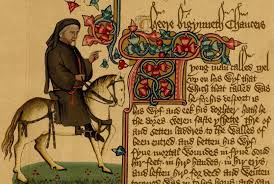
Why did Chaucer write the Canterbury tales?
It is very tough to find out the actual reason behind this magnum opus, The Canterbury Tales. History is quite an assailant when matters come about the origination of any ancient work of art. Time is mum in certain cases.
If we throw some light on the career of Chaucer beside poetry, then we can see he was a very successful employee always close to the imperial power. Thus it may seem to concoct a tale and to gain popularity for him would have been easy.
Despite that, if we look inside his other works like The House of Fame, Parlement of Foules, and The Book of Duchess, etc we can see that these works are aimed at perplexing the system. It was not so easy for a member of the regal staff at that time. Therein lays the ambiguity of the man who is the precursor of modern English Literature.
In the case of The Canterbury Tales, we can also see that poet is trying to create awareness against social problems. He is invoking the reasoning of men through stories. He is commissioning the awareness of the collective through a collective travelogue, maybe the first of its kind in the History of literature.


In the prologue of the wife of bath’s, we see that the wife is arguing with the pilgrims who believe it is wrong to get married more than once. She describes her own life. She says how did she dominate and control her five husbands and most interestingly a friar spoke out loud against her.
From the above section, we try to understand the situation of women in society at that time. Women had to be a rebel to get control over their men. Now if we think about the friar who shouted against these, we would apprehend that he was nothing but the representative of the society who thinks not men, women must be dominated.
Chaucer herein laid his reservations against these stereotypes. At the ending of that tells a young knight was asked to choose the character of his wife between faithful and ugly or unfaithful and beautiful. He asked his wife to take the decision. As a reward of giving the control, his wife became beautiful and faithful.
There forth Chaucer had strained the problems of the society in every segment of the poem behind witty satire.
Chaucer’s prologue to The Canterbury tales
In the very beginning of Chaucer’s general prologue, he had described the nature; it helps us to understand the time period and the moment. He opens the description with the returning of spring. He narrates the rain of April, the flowers are being flourished, and birds are chirping here and there, a holy feeling is all over in the air.

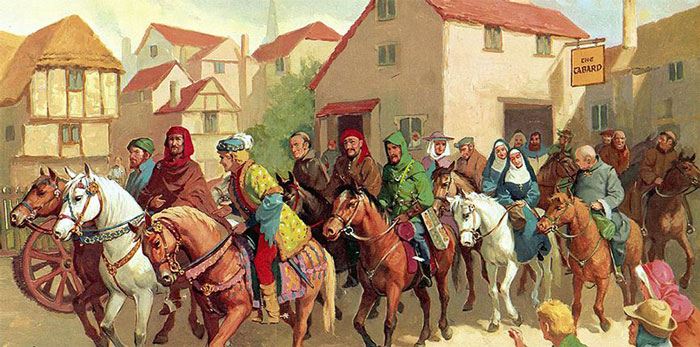
Spring was the time when pilgrims willed to go on a pilgrimage. The narrator was also intending to go. He set mind to make a journey to Canterbury to visit the relics of Saint Thomas Becket in Canterbury Cathedral.
Before starting the journey he spent a night at a tavern in Southwark named Tabard Inn. There he met a great company of twenty-nine pilgrims. The narrator was merrily accompanied with them on the journey towards the Canterbury Cathedral.
After that we get to know about the pilgrims, the narrator describes every single pilgrim. The most interesting fact what we can find out about the diversity of the pilgrims is that they are from different territories, most importantly from different classes. Despite that, they were not only happily going together but also sharing the stories of their lives as well as their views about the livelihood.
Characters of Chaucer’s The Canterbury tales
If we get to know about the characters of The Canterbury Tales we will understand the diversity.
The characters of the tale were twenty-nine pilgrims who were the knight, the miller, the reeve, the cook, the man of laws, the wife of bath, the friar, the summoner, the clerk, the merchant, the squire, the franklin, the physician, the pardoner, the shipman, the prioress, sir Thopas, Melibee, the monk, two nuns, the knight’s yeoman, the manciple, the parson, the tapestry maker, the dyer, the weaver, the carpenter, the haberdasher, and the host Harry Bailey.
Chaucer’s The Canterbury tales summary
After the prologue, we can see that the journey had been started. One of them named Harry Bailey, who was also the host, proposed to tell tales to reduce the fatigue of the journey. To make it more interesting he announced that whose tale will be loved most by others will get a free meal at the tavern, thus started the chronicle of telling tales.
If we peep in the bosom of the stories, we shall understand that they are not just chronicle of men but they are an etched and codified history of the lives of men in the medieval period.
The tales tell about every little problem of the very common people, maybe that is why it was largely celebrated among the common people, the mass.
Who is Chaucer in the Canterbury Tales?
Chaucer was the narrator who was accompanied by the twenty-nine pilgrims on his to Canterbury. We the readers can visualize the tale through his eyes.
Chaucer’s The Canterbury Tales’ PDF
The Canterbury tales is one of the highly acclaimed works of all time. In this discussion, we have tried to find out the reasons behind it. We get some essence about the greatness of the poet and learned a bit about the man who had the dare to question the system despite being a part of it.
But it is too little to quench the thirst. So here we have the whole tale for you. Go and read it. Read the most precious work of all time. See chart of Canterbury pilgrims.